This blog can now also be viewed at http://www.parentingwhatipreach.wordpress.com/.

Friday, February 5, 2010

Building Self Esteem Through What We Don't Say


There is a lot of research out there about body language and how the majority of what we communicate is through our nonverbals. In fact, one study at UCLA found that up to 93% of what we say is not through words. Our tone, our gestures and our facial expressions play a much larger role in what we communicate than the words that come out of our mouth.

Try it. Watch TV with the volume off and see if you can piece together what's happening in the scene. Interesting, huh?

Several years ago, I saw a segment on Oprah where they had parents give different facial reactions to their children when they picked them up from childcare (I tried to look up the episode to share better details with you but couldn't find it. If you know more about this episode, please share it with me). What they discovered was that children's self-esteem correlated to the types of nonverbals their parents gave them when they first saw them. Parents who barely made eye contact with their child, overlooked the child and focused on talking to the other adult in the room, or simply had a blank face had children who reported a lower self-esteem than those whose parent's face lit up when they saw their child, embraced them in a hug and used body language to show interest in their child. Words did not even have to be spoken. This demonstration is consistant with similar research done regarding parents' nonverbal communicaton with their children.

This knowledge is something that haunts me.

I don't want to send the message to my children that they are unimportant. Or even that they are just less important than other things in my life. I certainly don't want my nonverbal communication to be something that negatively impacts my children's self-esteem!

So, I intentionally try make sure the first and the last facial/body message that my children get from me is that I am happy that they are in my life and that I love them with all my heart. Some days this is more difficult than others. On days when we're running ten minutes late to school because of goofing around, or when the baby is crying and requiring a lot of my attention, or when I just flat-out don't feel good, making my body smile and my eyes light up with excitement and my arms wrap around a little body in a hug seems like moving dead weight. But more important than any of this is that my kids leave for their day with their self-esteem boosted knowing that their mommy loves them not just because those words came out of her mouth. And at the end of the day, they know they are coming home with someone who thinks the world of them and is not picking them up because it's just the next thing on my to-do list.

Many times I have to really think about it. I have to remind myself to show my excitement. I have to tell my eyes to soften. I have to open up my mouth in a big smile and widen my arms in preparation for an embrace. Not because I have to force myself to love my kids. More because I have to step out of my selfish world of I'm exhausted, I'm not in the mood, I just want to get out of here. In these moments I have to remember that I have three adorable children who just want reassurance that yes, even today, I am glad I'm their mommy.

This is not about being fake with my kids. I'm not suggesting that I cover up my stress, frustration, or sickness and give the "every thing's rainbows and roses" June Clever cheese ball hello and good bye. Anyone who knows me and my kids knows I'm pretty candid with them about how I'm feeling. But when it's all said and done. When they have heard how I feel. Can they SEE that despite it all I love them and think they are amazing?

What does 93% of me say to my kids on a day-to-day basis?

What are you saying to your kids?

Obviously, the same rules apply beyond just the Hellos and Good-Byes we give our kids. What other areas are our nonverbal communications just as important?

Tuesday, January 19, 2010

Talking About Haiti

Isabella and Nate were flipping through channels on the TV last week. Isabella paused for a moment on the news. Something caught her eye. "Oh," she said. "It's just about an earthquake." She went to reach for the remote to change the channel again.

I stopped her.

"Actually you guys," I said, "it's not just an earthquake. It's a very sad and terrible thing that has happened."

There is definitely balance needed when talking to kids about devastation, disasters, violence, hurt, heartache, death. Especially with young children. Things that happen outside their own sphere of experience, particularly events in another country far away, are abstract and difficult to get little minds around, regardless of whether it's good or bad. It's hard for adults to get our minds around.

And yet, I don't want to raise my children completely sheltered from the "bad" of the world despite the part of me that wants my children to believe the world is all about Popsicles, swings, and playgroups. It seems easier to let them believe that the only death in the world is the death of a pet fish and that "starving" is what we say when it's way past when we should have had dinner. Exposing them to the ugly side of life is a lot harder. But I want my kids to be compassionate toward others. I want them to learn that the world isn't all about them. That there are many hurting people in this world and we can play a role in healing some of those wounds. I don't want a child who sees the coverage of the earthquake in Haiti and it's victims to be so used to me changing the channel, just so they won't be upset by what they see, that they don't know to feel sorrow for the suffering of other people. Or worse, a child who doesn't even realize that there are other people in the world suffering while we sit in our warm house playing our Wii and eating chocolate brownies.

And so I told my children about the earthquake. I told them about how poor the country was and how little the people there had in concrete ways they could understand. I told them that the children there didn't have rooms full of toys and that many people there didn't even have televisions. I told them that many homes didn't have sinks and toilets with running water. They already had very little. And then the earthquake came and destroyed almost all of the buildings in the city. The very little they had got lost. Their homes fell. Their work places fell. Many many many people died. And the people there are very very sad and scared.

My kids grew silent processing what this all meant. Then they asked questions, and I let them. I helped them process the information they were hearing to the best of their developmental ability. But I also included hope for them. We talked about how people from all over the world were coming to help them. I told them people from our country were sending food and supplies. I told them our church and many other churches were praying for them and that they could, too.

Just as important, I reassured my children that this happened in a country far away. The earthquake was not in our city. We are safe. Our buildings are stronger. We have more resources. We are fortunate that our situation is very different from the people in Haiti.

All this having been said, we don't keep the television on with the Haiti images constantly rolling in front of our children. They don't need to see hours of disturbing pictures to learn the qualities I desire for them. We limit how much news we watch about it on TV because they are already getting it everywhere anyway. There's news teasers during the shows they watch. The d.j.'s on the radio discuss it. The kids are talking about it at school. I'm not worried that they are clueless to what's going on.

And now my role is to be available to them as I allow them to learn and experience this side of life. My kids have said they felt sad about Haiti. I need to be OK that they are sad. They have felt concerned, wondering if people are still helping them or was it just for one day? I'm thankful they're concerned and that they can be reassured that help is still coming, learning that a situation like this can't be "all better" in one day. Isabella has felt helpless. I've been able to talk to her about ways even she can help by giving some of her money, praying, even loving her own friends and family during this time. My kids are learning something valuable and I am here to teach and guide them through this learning process.

Events like the tragedy in Haiti are awful. But because I chose not to shelter my children from it, my kids are able to develop compassion for those less fortunate than they. They are able to develop empathy toward others who are outside of their world experience. They begin to understand that while the world is a bigger place than they realized, they can still have an impact on it. And they will ultimately be better individuals for it.

CBS News offered a great article that includes a video on some tips for talking to your kids about tragic events such as the one in Haiti if you would like more information on this topic. Click here for a link to that article.

Please share how you are talking to your kids about this and any questions or concerns you have encountered along the way.

Monday, January 4, 2010

Consistency and a Parking Lot Time Out

Ah, my sweet Nate. He is so in a phase right now. Challenging the rules. Being extra stubborn. Whining incessantly. Pushing buttons as often as he can. Trying to find the loopholes so that he can get away with whatever it is he wants to get away with for as long as he can.

When I'm not in the midst of experiencing his "phase", there is actually a part of me that loves this aspect of him. It's a glimpse into his personality that potentially will be a great quality to have if developed in a positive way. I love watching his brain at work. He's a smart kid. The way he thinks. His logic. It's great!

And he can drive us all crazy!

I can't begin to tell you how many times Nate has heard, "Stop" in the last couple weeks. My husband and I have thrown every parenting technique his way. I seriously think he is on a secret mission to see if he can break us. To be honest, there have been a few times where I have thought that he just might.

But the key to dealing with this behavior is consistency. It's hard sometimes. It's exhausting sometimes. It's inconvenient sometimes. But all times it's necessary if I want the undesired behavior to change.

The other day, he was picking on his sister. She told him to stop several times. He didn't. I told him to stop. He didn't. I pulled him aside and gave him a firm reminder of stopping when asked to stop or he would be choosing a time out. He said he understood. We got in the car.

As I pulled out of the parking spot Nate started in on another argument with his sister. She was saying, "it is" and he was saying, "it isn't" just to be contrary. I pointed out to Nate that this is an example of picking a fight with his sister and that I was going to jump in right then and say, "stop". This shouldn't have been a problem for him since we had just talked about this. But in the ever so soft whisper of my five-year-old (who remember is always seeking out the loophole) I hear, "it isn't".

By now we're at the stoplight. I don't say anything. The light turns green. I don't say anything. I drove the car into the first parking lot across the street from where we had been and pulled into a parking space. Nate perked up and asked, "What are we doing here, Mom?".

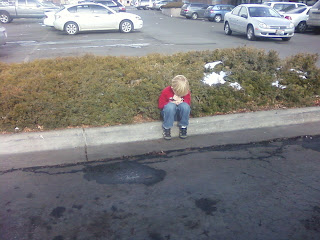
"Well, Nate," I replied, "we're here to do a time out. I told you that would happen if you weren't going to listen and stop when you were asked to stop. I told you to stop and you still chose to whisper 'it isn't" right after I had told you to stop." Nate's face sunk. I think it was more the look of, "Dang. She caught me." But he didn't argue. Nate got out of the car and did his time out on the curb in the parking lot while Isabella, the baby and I sat in the car.
Real quick side note here. Nate was perfectly safe. I was right there beside him. He wasn't freezing. I actually reduced his time from the typical five minutes to two-and-a-half because it was chilly. Time out is never punishment. My goal is not to make my kids suffer. The purpose is to follow through with the choices they make and always mean what I say regardless of where we are. As a result, my kids know that a time out can happen anywhere, even on the side of the road. Just because we're in a car does not mean consequences can't happen.

Nate was actually pretty sweet the rest of this day and did a great job of "stopping" when asked to stop the next time the opportunity presented itself. Consistency pays off.

I know there is more to come from him. But it won't last forever. In the meantime, I remember I love him and because of this I will do my best to stay consistent.